I wanted to use the topic of choosing colleges to talk a bit about what I only came to understand about American universities after actually getting to college. Maybe I was just pretty ignorant before, but after coming to the U.S., I realized universities here are nothing like what I had imagined.
To start with, I used to think that aside from charging higher tuition, private universities were just arbitrarily better than public ones in every other way. But honestly, that really isn’t true. And if we want to understand why, we should probably start from first principles—that is, by following the money.
A lot of people, including my past self, assume private universities must be rich. I mean, the tuition is so expensive, right? So they must have more resources. But honestly, for a huge institution, even if each of us pays a lot in tuition, it’s still just a drop in the bucket.
So where does a university’s money actually come from? A very large part of it comes from the federal government. If you’re hearing this idea for the first time, it probably sounds deeply counterintuitive. To be honest, before college I always thought a school was either private or state-funded, and aside from military academies, other universities shouldn’t really have much to do with the federal government. But in reality, the NSF, the Department of Energy, the NIH, and the Department of Defense / military cover the vast majority of research spending in the U.S., especially for STEM fields. Of course, other departments and agencies also have their own funding projects to support research to varying degrees. So in American universities, the main job of a STEM professor is actually neither doing research nor teaching—it’s going around asking for money. And that’s why university labs are, in essence, a lot like startups. The professor is like the founder/CEO: probably not handling the really specific day-to-day stuff, but setting the overall direction and going out to raise money. So how does that money get raised? Or in other words, how do grants get applied for? That’s the professor’s most important job: writing proposals, basically grinding out grant applications. It’s kind of like bidding on a contract. The federal government first puts out a project call, then professors submit their proposals and wait to hear back. After all that, it might sound like the only parties involved are the professor and the federal government, so what does the university have to do with any of it? Well—exactly. While the professor is diligently writing the proposal, the university barely seems to exist. But once the proposal gets funded and the money is about to come in, the university pops out to collect its cut—something called overhead. For example: if a professor gets a $1 million grant from the Department of Energy, DOE doesn’t just pay the professor that $1 million. It also has to pay the university an additional amount based on the overhead rate. In general, the overhead rate on federal funding is pretty high—sometimes as high as 80%. That means a $1 million grant actually costs DOE $1.8 million, or put another way, the professor effectively “loses” $800,000. Is that charge justified? I’m not trying to argue that here. Universities do have huge logistical and administrative systems, and without them, professors and students couldn’t fully focus on research. But those systems are also often bloated. In any case, the takeaway is that a lot of university money actually comes from the federal government. The school is more like a platform provider, while whether things are truly flush or not depends more on the academic brand of the professors themselves—kind of like a multi-strategy hedge fund. That’s also why American academia is so diverse and decentralized, rather than being monopolized by just a few elite schools. But this is only a very simple introduction to that phenomenon; I’ll come back to the more specific reasons later.
At this point, I’m sure some people are about to ask: what about endowment funds? Private universities have so many rich alumni donating so much money—can that really not outweigh federal funding? Fair point. But in practice there are a lot of complications. The biggest one is how freely that money can actually be used. First, a university’s endowment fund is basically like a family office / trust fund. In general, the school can spend only the investment returns, not the principal. So the portion available each year is only around 5% to 10% (I haven’t done rigorous research on this, but that’s probably not too different from some pretty good hedge funds). But don’t think that once the returns come in, the university can just kick back and develop the school however it wants. In reality, most donors place strict restrictions on how their gifts can be used. For example, you often see things like a Certain Family Scholarship at a university, or a building named after some individual. In most cases, that means the donation was earmarked from the start to support one small part of the school, rather than being flexible money the university can use however it wants.
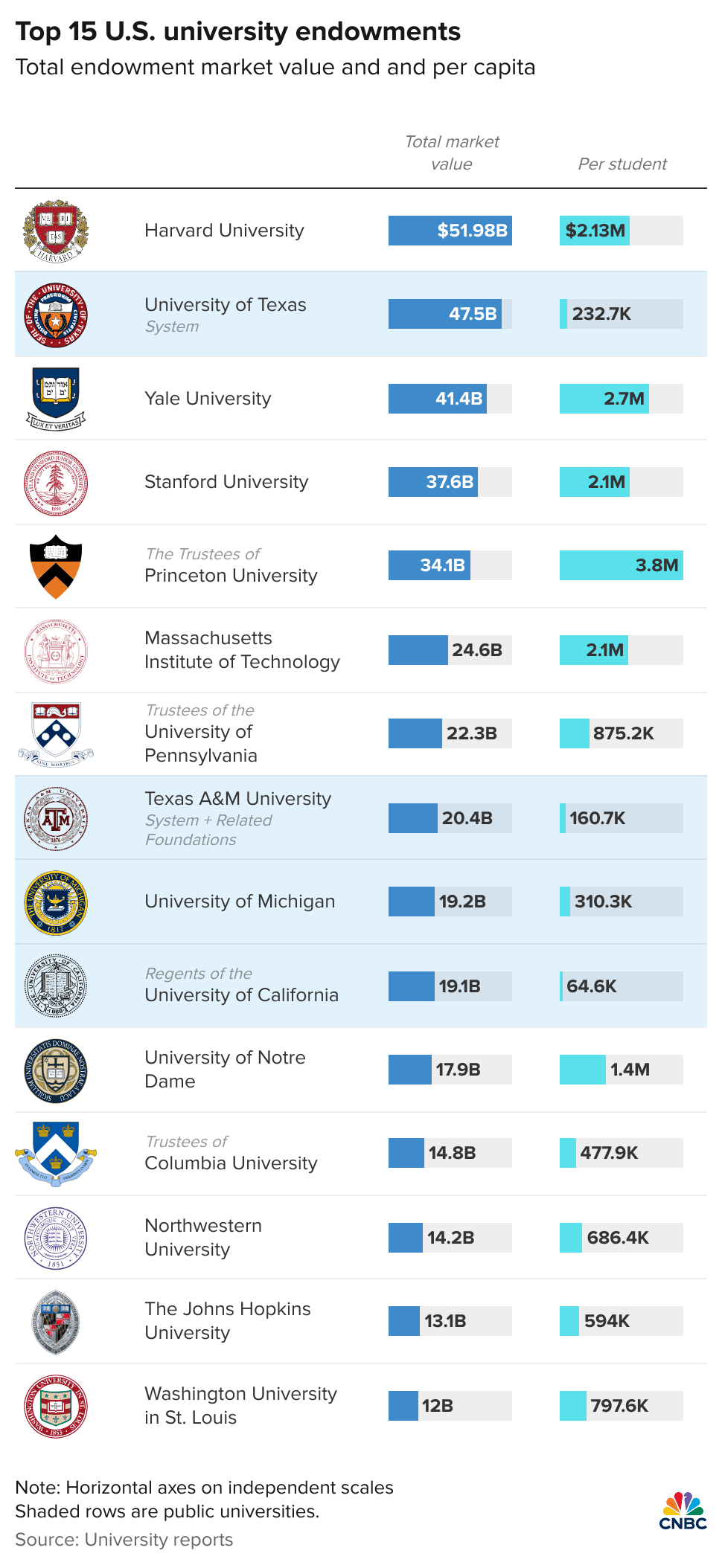
Source: How university endowments work, CNBC, April 2025.
This chart roughly shows the endowment situations at different universities. Some of the blue-highlighted ones (like the University of Texas System and Texas A&M) are public universities. I have to say, schools in Texas really are rich. But because these public universities have so many people, they run into the problem of “abundant in total, insufficient per capita.” It’s like Wen Jiabao’s famous “multiply and divide by 1.3 billion” line: “In China, any tiny problem, once multiplied by 1.3 billion, becomes an enormous problem; and any huge aggregate, once divided by 1.3 billion, shrinks into an insignificant number.” So for public universities, even if their endowments and federal grants are huge, once you average that out across their massive student bodies, it can still feel thin per student. But is that really the whole story?
Here too, it helps to start from the root of the issue and understand why state universities enroll so many students. The reason is actually simple: state universities receive a great deal of funding from state governments each year, so by law they must admit a certain proportion of in-state students (usually over 80%). That makes it relatively easier for in-state high school students to get into those schools, but it also means the student body can vary a lot in level. So what does that mean for us UWC students? Suppose your own ability stays fixed: at an Ivy League school you might be around the top 50%, but at many state universities you might be in the top 10% or even top 5%. What you do need to prepare yourself for, though, is that the top 3% at a state university are often every bit as strong as the top 5% at the Ivies. In other words, the very best students are basically on the same level; state universities just have a much more pronounced long tail. Another thing worth noting is that although state universities are huge, they do not necessarily have fewer resources than private universities. In their strongest disciplines, they can even far surpass the overwhelming majority of private schools (for example, the total CS resources at UC Berkeley and UIUC absolutely exceed those at every private university except the very top few). So if the overall pool of resources is large enough, and you yourself are very strong—meaning your competitors are only people around your level or stronger—then for students who are not at the absolute top tier (say, IOI medal level or similar), state universities may actually offer more resources. There was once a professor at CMU who explicitly said that when recruiting Research Assistants, they would only consider people from certain years of IOI/IMO and above a certain score threshold—and the cutoff changed from year to year. That is probably the most brutally honest illustration of this phenomenon.
So I really think choosing a college should be about finding a school that genuinely fits you, not getting dragged around by reputation. Honestly, it was only after I came to the U.S. that I started to feel that undergraduate education at some schools is almost like a luxury good, especially for STEM. If you’re someone who is sharp-edged and openly brilliant, then those schools are probably a great fit—you’ll have an easier time finding your place there (not necessarily in the sense of achieving more, but vibe-wise resonating with the school, and in that sense you may simply be happier). But if you’re more low-key and practical, Hermès usually isn’t as useful as a canvas tote. This is actually the thing I most want to say to younger students. If someone had told me this when I was applying, I probably wouldn’t have applied to some schools that now seem extremely ill-suited to me just because of fame. Instead, I might have chosen schools that fit me better, and used my limited application slots on schools that were truly more top-tier.
Alright, finally, let me explain more systematically why American academia is so diverse rather than dominated by just a few institutions. The federal funding I mentioned earlier is only an indirect reason. One of the most direct reasons is that getting a faculty job in the U.S. is now basically hell-level hard. In practice, only the very best PhDs from the very best schools can land faculty positions at schools that are, relatively speaking, still pretty good. Using CS, which I know better, as an example: it is honestly not an exaggeration to say that almost nobody can get a Tenure-track Assistant Professor position (basically the first stop for PhD students who want to go into academia, abbreviated TTAP) without first doing a postdoc. Quite a few former IOI national team members have had to do two or three years—or even three to five years—of postdoc work before finally landing a faculty job (and other fields are honestly not that different). And what about faculty jobs at top universities? That’s where it really becomes a clash of titans. Take the CS department at my school, UIUC, for example: among the TTAP hires in AI over the past couple of years, quite a few were already absolute giants with ten thousand, twenty thousand, even thirty thousand citations before they even started the job. Of course, AI naturally racks up more citations than other areas of CS and more than many other disciplines, but still—that’s a pretty insane number. On top of that, the randomness in the faculty job market is much greater than in college admissions. Generally speaking, for a professor to get hired, it’s already hard enough that no one on the search committee actively dislikes them; on top of that, there also needs to be at least one person who really, really wants them. And that’s why a lot of truly outstanding PhD students end up at somewhat less famous schools. So for people like us, you really don’t have to go to a top-top school. As long as you go to a university that’s relatively good, you will meet very impressive professors. Does that mean better schools have no advantage at all? Not really. If we borrow characters from Jin Yong wuxia novels as an analogy, then among the top five or ten schools you may find several professors at the level of Dongxie or Xidu—true grandmasters—plus a whole group at the level of Guo Jing. But even at more ordinary schools, you’ll still have at least a few Guo Jing-level professors. So the gap is nowhere near as big as many people imagine.
For people who don’t plan to do research, having lots of professors—especially lots of strong professors—also brings many benefits. For example, the course offerings will usually be much more comprehensive: whatever field you want to study, there’ll be someone there to teach it. This is actually a major weakness of liberal arts colleges. Because although liberal arts colleges aim to be small, refined, and teaching-focused, each department also tends to be much smaller, which means they may only be able to offer courses in a few mainstream directions. That said, schools like Barnard or Wellesley have lots of partnerships with nearby top universities. Wellesley students, for example, can take classes at Harvard and MIT, which instantly makes up for a lot of the resource gap.
But at the end of the day, schools are often more like providers of opportunities, resources, and platforms, while a person’s growth ultimately still comes back to themselves. As Chairman Wang Jiapeng often tells us: “Each of you is the chairman of your own life company; we (meaning teachers, parents, schools) are only board members.” So no matter where you end up, what matters more is slowly figuring out what kind of person you want to become and what kind of life you want to live, and then seriously walking in that direction. A lot of things may not have immediate answers, but if you’re willing to invest yourself and willing to keep going, you’ll often carve out your own path little by little. A lot of the time, compared with these external labels, what matters more is whether you’re actually happy (see “On Setbacks” for more). If the competitive lens in the discussion above feels a bit overwhelming to you, or if you just genuinely like a certain school, even if it wouldn’t count as the most optimal fit by the standards I used earlier, that is completely fine. In the end, choosing a college is not a multiple-choice question with one correct answer. It’s about choosing a place that suits your life and growth a little better. And the only standard that really matters is whether you can live there comfortably and happily.
That more or less covers American universities from an academic perspective. But college life is definitely not just about academics—there are many other things that matter just as much, or even more. The most obvious one is location. Sometimes I even think location can matter more than academics. Because it directly affects how easy it is to travel, which has a huge impact on going out for fun / going home / job hunting (that is, onsite interviews) / conference travel. For example, the last time I went to New York for an event, even people who didn’t go to college in New York—say, students at Princeton in neighboring New Jersey—could basically just take a one-hour car ride and be there. But for someone like me, studying out in rural central Illinois, I have to take a bus (more than three hours) / or first take a car ride (more than two hours) / or fly (one hour) to an airport in Chicago, and then fly from Chicago to New York. Even if the flight isn’t delayed, half the day is basically gone. It’s genuinely very inconvenient. And if it’s for an interview, all that travel exhaustion can really affect your state, so in general you need to arrive a day early—which means staying two nights at the destination. So overall, I think at the very least it’s much more convenient to be in a city with a major airport. The Duke/UNC/NC State area, for example, is fantastic. Those three schools are basically all within a fifteen-minute drive of one another, and the airport is only about twenty minutes away. At the same time, that area doesn’t have the chaos of a big city. We’ll probably do a whole series on American cities later, so stay tuned!
Besides that, another very important issue is tuition. Thankfully, UWC students are all eligible to apply for the Davis Scholarship. I’m not very familiar with the actual process, though, so maybe later we can ask someone who knows it well to write a separate piece about it in detail.