I wanted to use the topic of choosing colleges to talk a bit about what I only came to understand about American universities after actually getting to college. Maybe I was just pretty ignorant before, but after coming to the U.S., I realized universities here are nothing like what I had imagined.
Where Does a University’s Money Come From
To start with, I used to think that aside from charging higher tuition, private universities were just arbitrarily better than public ones in every other way. But honestly, that really isn’t true. And if we want to understand why, we should probably start from first principles—that is, by following the money.
Federal Funding and Overhead
A lot of people, including my past self, assume private universities must be rich. I mean, the tuition is so expensive, right? So they must have more resources. But honestly, tuition is just one slice of a research-heavy research university’s massive revenue mix. Spread across research infrastructure, hospital operations, new-faculty startup funds, and administrative and compliance costs, what each of us pays in tuition ends up having pretty limited impact on what the school can actually deliver in terms of resources.
So where does the money that actually determines a school’s academic strength and research capacity come from? A very large part of it comes from the federal government. If you’re hearing this idea for the first time, it probably sounds deeply counterintuitive. To be honest, before college I always thought a school was either private or state-funded, and aside from military academies, other universities shouldn’t really have much to do with the federal government. But in reality, the NSF, the Department of Energy, the NIH, and the Department of Defense / military cover a very large share of research spending in the U.S., especially for STEM fields. Of course, other departments and agencies also have their own funding projects to support research to varying degrees. So in American universities, the main job of a STEM professor is actually neither doing research nor teaching—it’s going around asking for money. And that’s why university labs are, in essence, a lot like startups. The professor is like the founder/CEO: probably not handling the really specific day-to-day stuff, but setting the overall direction and going out to raise money. So how does that money get raised? Or in other words, how do grants get applied for? That’s the professor’s most important job: writing proposals, basically grinding out grant applications.
This is kind of like bidding on a contract, but more flexible. For the main programs at NSF and NIH, the federal government opens applications on a fixed annual cycle, and professors decide their own research directions, submit proposals, and have them reviewed by a panel. For DARPA and certain DOE programs, the process is closer to traditional bidding: the federal government first lays out specific research priorities and then collects proposals. After all that, it might sound like the only parties involved are the professor and the federal government, so what does the university have to do with any of it? Well—exactly. While the professor is diligently writing the proposal, the university barely seems to exist. But once the proposal gets funded and the money is about to come in, the university pops out to collect its cut—something called overhead. For example: if a professor gets a \$1 million grant from the Department of Energy, DOE doesn’t just pay the professor that \$1 million. It also has to pay the university an additional amount based on the overhead rate. In general, the overhead rate on federal funding is pretty high—at top research universities, it typically sits between 55-70%. (Strictly speaking, overhead isn’t an extra tax the school collects—it’s an indirect cost the federal government already recognizes. The federal government knows that research requires buildings, IT, compliance, and administrative support, so it pays for these through overhead in a unified way. It just feels to individual professors like the school is taking money that could have gone into their own labs.)
Is that charge justified? I’m not trying to argue that here. Universities do have huge logistical and administrative systems, and without them, professors and students couldn’t fully focus on research; new faculty also often depend on startup funding from the school. But those administrative systems are often bloated. Although overhead isn’t the most visible line item in a university’s revenue (undergraduate tuition, housing, dining, and endowment returns are all more visible), for research universities, federal funding is the single largest source of research investment (accounting for 55% of U.S. higher-ed R&D spending in FY2024), and the overhead portion in particular is key to sustaining research infrastructure. For STEM professors, federal funding is the primary source of their research funding—it directly determines whether their lab can operate, whether they can admit students, and whether their research can continue, and it ultimately determines a school’s academic strength in a given field. Johns Hopkins is a particularly extreme outlier here. JHU is sustained by the defense / aerospace programs at its Applied Physics Laboratory: its FY2024 research expenditures of \$4.13 billion came in at nearly twice the #2 school (UPenn at \$2.17 billion), with about 88% coming from federal funding. JHU has led all U.S. universities in R&D expenditures for more than 40 consecutive years since 1979, and by a wide margin. Many people only think of JHU’s medical school, but what actually put it where it is today is decades of sustained federal defense and research funding. In any case, the takeaway is that a lot of university money actually comes from the federal government. The school is more like a platform provider, while whether things are truly flush or not depends more on the academic brand of the professors themselves—kind of like a multi-strategy hedge fund. That’s also why American academia is so diverse and decentralized, rather than being monopolized by just a few elite schools. But this is only a very simple introduction to that phenomenon; I’ll come back to the more specific reasons later.
The Reality of Endowments
At this point, I’m sure some people are about to ask: what about endowment funds? Private universities have so many rich alumni donating so much money—can that really not outweigh federal funding? Fair point. But in practice there are a lot of complications. The biggest one is how freely that money can actually be used. First, a university’s endowment fund is basically like a family office / trust fund. In general, the school can spend only the investment returns, not the principal. So the portion available each year is only around 5%. But don’t think that once the returns come in, the university can just kick back and develop the school however it wants. In reality, most donors place strict restrictions on how their gifts can be used. For example, you often see things like a Certain Family Scholarship at a university, or a building named after some individual. In most cases, that means the donation was earmarked from the start to support one small part of the school, rather than being flexible money the university can use however it wants. But this kind of restricted gift can actually enable things in specific areas that federal funding can’t. For example, it can let a school build a brand-new institute / department from zero, rather than only adding faculty and funding incrementally on top of existing structures. Princeton’s Lewis-Sigler Institute for Integrative Genomics, for instance, was established in 1998. Peter B. Lewis donated \$55 million in 1999, \$35 million of it endowing the institute’s fellows program; together with the Icahn Laboratory donated by Carl Icahn, basically Princeton’s entire quantitative biology / QCB ecosystem was launched off these two private gifts. Federal grants keep flowing in afterward to sustain operations and research expenditures (e.g. the NIH-NHGRI training program), but the seed capital came from private donors.
It’s worth adding: as the chart below shows, at the top five private universities, the endowment is large enough and the student body small enough (endowment per student is over \$2M). Note that “per student” here is just endowment size divided by number of students as an institutional-capacity metric—it doesn’t mean each student actually gets \$2M; the next section will unpack why per-capita math is misleading as a measure of individual access. But here, once per-student crosses the staggering \$2M threshold, the school’s institutional financial flexibility enters a different regime entirely, because the unrestricted slice alone is enough to do things federal money can’t, like offering aggressive retention packages to poach senior faculty who’ve already made their name elsewhere. But for the vast majority of other research universities, federal funding is still the main engine driving the research enterprise.
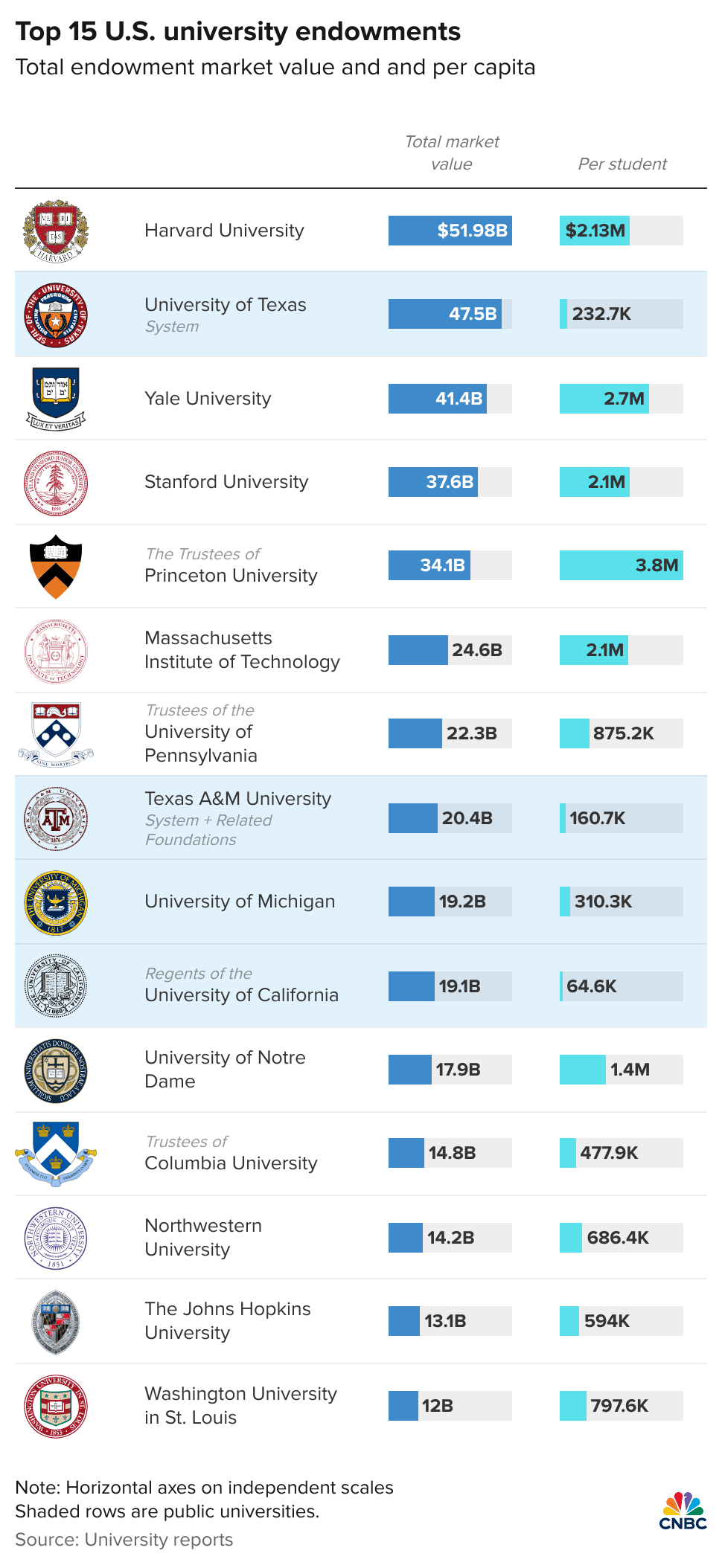
Source: How university endowments work, CNBC, April 2025.
This chart roughly shows the endowment situations at different universities. Among them, the blue-highlighted ones (like the University of Texas System and Texas A&M) are public universities. I have to say, thanks to oil money, schools in Texas really are rich. But because these public universities have so many people, they run into the problem of “abundant in total, insufficient per capita.” It’s like Wen Jiabao’s famous “multiply and divide by 1.3 billion” line: “In China, any tiny problem, once multiplied by 1.3 billion, becomes an enormous problem; and any huge aggregate, once divided by 1.3 billion, shrinks into an insignificant number.” So for public universities, even if their endowments and federal grants are huge, once you average that out across their massive student bodies, it can still feel thin per student. But is that really the whole story?
State Universities: Why So Big
Here too, it helps to start from the root of the issue and understand why state universities enroll so many students. The reason is actually simple: state universities receive a great deal of funding from state governments each year, so politically and legally they’re expected to prioritize in-state students. And populous states produce hundreds of thousands of high school graduates every year, so to absorb that college-age population, state university systems are naturally pushed to a huge scale—California’s University of California (237,616 undergraduates in fall 2025) and California State University (471,451 enrolled in fall 2025) systems alone together enroll more than 700,000 students.
As for the minimum in-state ratio, that varies a lot by state. Some states write the floor directly into state law or board policy: schools like University of North Carolina consistently maintain 80%+, and University of Florida and UT Austin keep their in-state undergraduate ratio around 90%; the UC system overall is also 80%+ in-state (UC Berkeley and UCLA sit around 80%, other campuses higher); while University of Michigan, University of Virginia, and others mostly sit in the 50-70% range. That makes it relatively easier for in-state high school students to get into those schools, but it also means the student body can vary a lot in level. So what does that mean for us UWC students? Suppose your own ability stays fixed: at an Ivy League school you might be around the top 50%, but at many state universities you might be in the top 20% or even top 10%. What you do need to prepare yourself for, though, is that the top 3% at public flagships like UC Berkeley and University of Washington are often every bit as strong as the top 5% at the Ivies. In other words, the very best students are basically on the same level; state universities just have a much more pronounced long tail.
Another thing worth noting is that although state universities are huge and look less prestigious, they do not necessarily have fewer resources than private universities. In their strongest disciplines, they can even far surpass the overwhelming majority of private schools (for example, the total CS resources at UC Berkeley, UIUC, and University of Washington absolutely exceed those at every private university except the very top few). So the simple per-capita math from earlier is actually pretty misleading—because access has never been divided evenly by headcount, it’s regulated by the demand side. So if the overall pool of resources is large enough, and you yourself are very strong—meaning your competitors are only people around your level or stronger—then for students who are not at the absolute top tier (say, below IOI medal level—I mean ability, not necessarily the actual medal, but even so this tier is much narrower than the “top 5%” mentioned earlier, which I’ll unpack in detail later), state universities may actually offer more resources. This is because while top schools may have more resources on paper, the access bar is also extremely high. (Quick caveat on what “top school” means here: I’m referring to the few that are top-tier in actual academic strength, not the ones that mostly ride on reputation.) For example, CMU professor Richard Peng flat-out states on his homepage that due to his own bandwidth constraints, to join his research projects, applicants need “IMO scores at least 30, or IOI rank top 9, or consistently reproducible performances on equivalents of the 2018-2025 versions of these tests.” That is probably the most brutally honest illustration of this phenomenon. (This is admittedly a fairly extreme example.) At most other schools, the access bar for professors of comparable caliber is generally much friendlier.
Hermès or Canvas Tote
So I really think choosing a college should be about finding a school that genuinely fits you, not getting dragged around by reputation. Honestly, it was only after I came to the U.S. that I started to feel that a few schools have decent academic strength, but their name is mostly carried by reputation—they’re a lot like luxury goods. If you’re someone who is sharp-edged and openly brilliant, then those schools are probably a great fit—you’ll have an easier time finding your place there (not necessarily in the sense of achieving more, but vibe-wise resonating with the school, and in that sense you may simply be happier). But if you’re the kind of person who prefers to quietly focus on doing the work well, Hermès usually isn’t as useful as a canvas tote. This is actually the thing I most want to say to younger students. If someone had told me this when I was applying, I probably wouldn’t have applied to some schools that now seem extremely ill-suited to me just because of fame. Instead, I might have chosen schools that fit me better, and used my limited application slots on schools that actually live up to their reputation.
Is a Low Acceptance Rate Really Something to Be Proud Of
I want to take a small detour here into a phenomenon I find pretty interesting: a lot of universities’ admissions offices and their own students love to flaunt how low their acceptance rate is, as if the lower it gets, the more there is to be proud of.
For a company, of course the lower the acceptance rate the better—the more selective the better. Companies are for-profit by nature and exist to create value for shareholders, so picking one in ten thousand for every employee is a perfectly reasonable business decision.
For universities, though, this logic doesn’t really apply. The vast majority of American higher-education institutions are legally non-profit organizations and enjoy tax-exempt status; more importantly, almost every school has mission-statement language along the lines of “advancing knowledge” and “serving humanity.” That language is actually very close to the values we at UWC have always been passing on. “Make education a force to unite people, nations and cultures for peace and a sustainable future”—the UWC mission—is never about how many people education filters out, but about how many people from different backgrounds get to come together, see one another, and change one another because of education. It’s precisely for this reason that these universities likewise emphasize diversity, access, and global citizenship in their admissions materials, and even open special application channels for UWC students, assign dedicated admissions officers to review UWC students’ applications, and jointly set up the Davis UWC Scholars Program, among other things.
But the logic of taking pride in selectivity is exactly the reverse: it treats “how many people we filtered out” as proof of its own value. The more a school prides itself on selectivity, the more it endorses a “scarcity equals value” commercial logic. That commercial logic is fine in the context of luxury-goods marketing, but it sits a bit awkwardly inside a non-profit higher-education institution whose mission is “serving humanity.”
So I think how many people a school admitted—how many people from different backgrounds got to come in and receive the best education in the world—is actually closer to what “serving humanity” was originally meant to mean than how many people it turned away. A low acceptance rate driven by limited spots may be objectively unavoidable, but at the end of the day it’s something to be regretted rather than something to take pride in. Of course, sometimes we UWC students and the admissions offices don’t necessarily do all that well on this front either.
Why Great Professors Aren’t Concentrated at Top Schools
Faculty Hiring Is Random
Alright, finally, let me explain more systematically why American academia is so diverse rather than dominated by just a few institutions. The federal funding I mentioned earlier is only an indirect reason. One of the most direct reasons is that getting a faculty job in the U.S. is now basically hell-level hard. In practice, only the very best PhDs from the very best schools can land faculty positions at schools that are, relatively speaking, still pretty good. Using CS, which I know better, as an example: these days, going straight to a Tenure-track Assistant Professor position (basically the first stop for PhD students who want to go into academia, abbreviated TTAP) without first doing a postdoc is getting harder and harder. Even some IOI medalists have had to do two or three years—or even three to five years—of postdoc work before finally landing a faculty job (and other fields are honestly not that different). And what about faculty jobs at the relatively good schools? That’s where it really becomes a clash of titans. Take the CS department at my school, UIUC, for example: among the TTAP hires in AI over the past couple of years, some were already absolute giants with ten thousand, twenty thousand, even thirty thousand citations before they even started the job. Of course, AI naturally racks up more citations than other areas of CS and more than many other disciplines, and the recent GenAI boom has meant that some researchers whose PhDs coincided with seminal work graduated with tens of thousands of citations already under their belt; on top of that, a subset had stints at industry labs like Meta FAIR, Google DeepMind, or OpenAI as a springboard. Even so, this level of citations is still pretty wild by any academic standard.
Beyond that, there’s another important criterion when top universities hire TTAPs: they want someone whose current research direction is the next big wave—in other words, the search committee is not just looking for people who are doing well right now, but for the next generation of people who will define the future of the field. On top of that, the randomness in the faculty job market is much greater than in college admissions. Generally speaking, hiring a faculty member means satisfying structural constraints like research-area fit and teaching needs, while also having no one on the search committee strongly opposed and at least one or two strong advocates. A failure on any one of these can knock out an excellent candidate. And that’s why a lot of truly impressive PhD students end up at somewhat less famous schools. So for people like us, you really don’t have to go to a top-top school. As long as you go to a university that’s relatively good, you will meet very impressive professors.
Take two schools I’m relatively familiar with that many people wouldn’t consider particularly strong as an example: University of Illinois Chicago (UIC) and University of Tennessee, Knoxville (UTK). Both have true heavyweights on their faculty. For example, UIC’s Philip S. Yu has spent over four decades in data mining, with a citation count and h-index that are both among the very highest of any CS scholar in the world, and UTK’s Jack Dongarra is the 2021 Turing Award laureate and an absolute titan of high-performance computing—now emeritus, but still actively advising students. These schools may not rank prominently on US News or CSRankings, but they have world-class researchers in their areas of strength.
Does that mean better schools have no advantage at all? Not really. If we borrow an analogy from Jin Yong’s classic Chinese martial-arts novels, then among the top five or ten schools per discipline you may find several professors at the level of Dongxie or Xidu—legendary grandmasters—plus a whole group at the level of Guo Jing, a famously strong hero. But even at most R1 universities (that is, the roughly 200 strongest research universities), you’ll still have at least a few Guo Jing-level professors. If you prefer a more Western pop-culture analogy, think of Star Wars: the top schools per discipline may have a few Yoda-level figures plus a whole group of Obi-Wan-level ones, while most of those R1 universities still usually have a few Obi-Wan-level professors. So the gap is nowhere near as big as many people imagine. Sticking with CS as the example: every year the top-10 CS programs collectively produce several hundred PhDs, but those programs themselves only hire twenty or thirty TTAPs combined—everyone else who wants a faculty job inevitably ends up at other schools, and once you factor in the search-committee randomness mentioned earlier, the correlation between getting into one of those programs and actual ability isn’t nearly as strong as people assume—so the PhDs who end up teaching at other schools aren’t necessarily any weaker. That’s why a mid-tier R1 department tends to have a lot of faculty whose PhDs come from the very top schools: it’s an inevitability of the hiring funnel, not a coincidence. The specific numbers in other fields may differ, but the situation is broadly similar—if anything, even harder, since they don’t have CS’s high-paying industry jobs to siphon off top talent. (Recommended watching: How to be the #1 pick from a pool of 200+ competitors—you can get a sense for just how hard R1 faculty hiring really is. In the video, Wenhao Sun, a materials-science professor at the University of Michigan, also briefly walks through his own faculty job search: in his first year he applied to 12 schools and made it to the phone + onsite interviews at UW–Madison and Harvard, but received no offers; in his second year he applied to 15 schools and came up empty—he didn’t even land a single phone interview; in his third year he again applied to 15 schools, made it to the phone + onsite interviews at NYU and the University of Michigan, and ultimately received a TTAP offer from the University of Michigan. That’s a glimpse of just how random and brutal the faculty market really is.) This is really the core point I want to make: in the U.S., because the competition for faculty positions is so fierce and because research funding follows the professor rather than the institution, excellent researchers are actually spread across universities of all tiers, not concentrated in just a handful of top schools as many people imagine. For how to actually identify a good researcher, see the CSRankings limitations and which schools are strong where section in On Computer Science; the approach there applies to essentially every discipline.
Ceiling × Demand Framework
One common misconception worth addressing here: some people might think, “I’ll go to a top school so I can have access to more academic heavyweights.” Top schools do have a bigger supply of top-tier faculty / PhD students / postdocs—the absolute counts are typically several times those at a mid-tier R1. But the demand side scales much more steeply than the supply side: supply roughly grows linearly with school size and quality, while the strongest undergrads (think IMO / IOI gold medalists) concentrate at top schools in a highly nonlinear way. The structure of that demand side is actually worth unpacking more than the supply side, because it directly determines what an ordinary UWC graduate (myself included) can actually access on a given campus.
For example, suppose an “ordinarily outstanding” UWC student who got into MIT wants to do research, with their ideal advisor being a top researcher like the Prof. Dongarra mentioned earlier. They’d find that the surrounding talent structure is a complete pyramid—at the very top sit IMO / IOI gold medalists and Putnam fellows—outliers who can’t even be described in percentile terms; the next tier consists of national-team members of various international competitions; below that are college-stage strong students at the level of ICPC North America Championship finalists (a tier already much narrower than the “top 5% at the Ivies” mentioned earlier); and at the bottom there is still a large group of similarly “ordinarily outstanding” MIT undergrads. The flip side, though, is that this actually highlights the advantage of non-top schools. At a non-top school, the top two tiers of this pyramid are basically missing, and an ICPC North America Championship finalist there is very likely already the apex. Top-tier professors have limited bandwidth too (perhaps a handful per department), but outlier peers are essentially nonexistent, so access is easier, and once you have access the relative position is friendlier as well. Of course, by the time everyone graduates and hits the market, they’ll all be evaluated together in the end. But the value of more access during four undergrad years is that it lets us accumulate more “incremental excellence” on top of an unchanged “baseline excellence”—not that it lets us check out entirely.
Two things to add: first, I’m using IMO / IOI here only because the outlier markers in CS and math are the most well-known, but the same pyramid structure holds across every field. Second, in practice a substantial fraction of students at both top schools and non-top schools “participate in undergrad research”—but that statistic is meaningless, because “participating in undergrad research” lumps washing dishes and running scripts together with receiving substantive guidance. Moreover, the real supply-side advantage at top schools is at the top-tier faculty layer, but their bandwidth is most likely going to be absorbed by the outliers. That said, it’s worth noting that the institutional design at top schools—for example, MIT’s UROP—makes sure that even bottom 10% students have a chance to get involved in research. But the actual attention and output that “involvement” yields is comparable to what they’d get access to at a non-top school, because their absolute ability is already not low. So the floor that institutional design provides is real, but the access advantage it gives many students is smaller than it looks.
That mostly covers the supply/demand structure around faculty. But undergrad research experience also has another supply-side dimension—one closer to daily life—that often gets overlooked: the quality of PhD students and postdocs. Because faculty spend most of their time chasing funding, on a day-to-day basis the people an undergrad actually interacts with in a lab are PhD students and postdocs—and their level is the real ceiling on an undergrad’s research experience. There’s a key asymmetry here: undergrad admissions is often prestige-driven, but PhD admissions is field-specific (driven by a program’s standing within its field, and most of the time it actually comes down to the strength of the specific PhD advisor). So a school with a modest overall ranking but top-tier standing in a particular discipline, or an especially strong individual professor, can attract incoming students whose quality easily outclasses a top-five-overall school that happens to be weak in that field. And this is only looking at the “stock” quality at the point of PhD admission; on top of that, in a recent May 2026 working paper by Josh Angrist and co-authors, using economics as a field-specific case, they further show that even after controlling for incoming student quality, PhDs from top economics programs have substantially higher long-run research output than PhDs elsewhere—meaning the program itself opens up another gap on the “flow” side. Stacked on top of the original “stock” quality, this means the average research output of PhDs out of field-top programs ends up quite a bit ahead of those elsewhere.
This is exactly why a program’s strength within a specific field matters far more than overall ranking. That said, most schools still get dwarfed by schools like Stanford that are strong across the board. And remember this is just the supply-side ceiling—combined with the demand-side analysis above, whether an “ordinarily outstanding” UWC student can actually access that ceiling at the end of the day is a separate question. So for most people, a sweet spot is actually a non-top school that’s top-tier in your specific field: the ceiling is already high, and the competitor pool is much friendlier than at top schools.
One important caveat: the argument above mainly applies to lab- / large-collaborator- / research-infrastructure-dependent lab-based research—experimental physics, chemistry, biology, engineering, experimental CS, medical research, and so on. For fields that run on advisor-1-on-1 + reading group / seminar mentorship—including theoretical directions in STEM (pure math, theoretical CS, theoretical physics), the humanities (philosophy, literature, history, classics, art history), the social sciences (economics, political science, sociology, anthropology, etc., whether empirical or theoretical), and business research (finance, accounting, marketing)—the ceiling driver is completely different: mentorship comes mostly from direct 1-on-1 with the advisor plus the peer effect of the reading group / seminar, so the advisor’s individual reputation and daily peer density matter more. Students in these fields still get crushed on access by outliers (every professor’s bandwidth is still limited), but because in these fields reading groups and seminars are also a core part of both learning and research, the daily peer effect there matters much more than in lab-based research. So for these fields, parts of the supply/demand framework above don’t directly apply and need to be analyzed separately. Readers interested in this can head over to E_P_silon’s So-Called Elite Schools.
How to Audit a School
To wrap up, let me thread the lab-based-research strands together so you can audit any school yourself.
The chain driving STEM frontier research roughly looks like this: federal funding follows top faculty → concentration of top faculty determines a program’s research investment scale in a given field → research investment scale + faculty quality determine the PhD / postdoc quality the program can attract in that field → PhD / postdocs (not the faculty themselves) are the actual ceiling on an undergrad’s daily mentorship, because professors spend most of their time fundraising rather than day-to-day mentoring → but whether you actually reach that ceiling depends on the demand-side outlier concentration on that campus (i.e., how strong the students sharing the same professor’s and mentor’s time are).
So for an “ordinarily outstanding” UWC student who wants to do STEM research, the optimal choice is neither the highest-ranked school overall nor the most prestigious, but a school whose ceiling is already high enough while the demand side isn’t too crowded—possibly a top field-specific public flagship (e.g., Penn State for materials science, Texas A&M for petroleum engineering), possibly some highly ranked private that doesn’t get swarmed by outliers (like Duke, JHU, or Northwestern in their respective strong fields), or possibly a mid-tier R1 with a standout strong area (e.g., UIC for data mining, UTK for high-performance computing, University of Utah for computer graphics).
As a side note, the observation that “the top-school premium for undergrads is smaller than reputation suggests” has long had a classic empirical validation in economics. In their paper published in the 2002 Quarterly Journal of Economics, Stacy Berg Dale and Alan Krueger match high school students who applied to the same set of schools and received the same admissions outcomes (using the application set and outcomes as a proxy for unobserved ability to absorb selection bias) and find that the earnings premium from attending a more selective college is essentially insignificant for most students, with low-income students being the exception. That said, Dale-Krueger estimate the average effect of attending a more selective college—i.e., “on average, what is the marginal contribution of going to a more selective college on earnings”—and don’t directly address how within-school access is allocated. The demand-side outlier argument in this piece fills in exactly that layer from the research-opportunity angle: even within a top school, research access is regulated by outlier concentration, so the marginal value an “ordinarily outstanding” undergrad can actually access at a top school takes a further haircut from demand-side dynamics on top of the average effect that Dale-Krueger measure. In other words, they show on the earnings outcome that the average premium is already small, and this piece extends that to the research-access dimension by pointing out that even when the average premium isn’t zero, its within-school distribution is highly unequal—which means the share an “ordinarily outstanding” student receives is even lower than the average.
Choosing a School for Industry
For students who don’t want to do research and instead aim to go straight to industry after undergrad, most of the framework above still applies, but with a few additions. The part that still applies is the ceiling logic: a program’s placement in a given industry roughly tracks its academic reputation in that field. The parts that need to be added bring in two independent factors: first, industry clusters—e.g., schools near Houston are strong in energy and aerospace, the Research Triangle area excels in biomedical research, and the Silicon Valley dividend enjoyed by all those California schools is too obvious to belabor; second, the field distribution of alumni networks—certain schools have alumni density in specific industries (or even specific companies) that’s far higher than their overall ranking would suggest, like the University of Southern California for Hollywood and the broader film/TV industry, or Dartmouth for the MBB consulting firms, or the University of Iowa for the literary publishing world. Together, these two factors make many schools punch well above their overall rankings in specific industries. The variation across majors here is huge, so the specifics will be left to the field-specific posts. So really, you don’t need to feel like you’ve missed out on something just because you didn’t get into a top-tier university—as long as you go to a reasonably good school, you’ll find excellent professors and rich academic resources around you. Make the most of those opportunities, and you can do just as well.
Liberal Arts College or Research University
Now, one last question many students agonize over: how do you choose between a liberal arts college (LAC) and a research university? The two actually have quite different orientations. Research universities, with their larger size and more faculty, naturally offer much broader course coverage—pretty much whatever field you want to study, there’ll be a course for it. Liberal arts colleges take the small-and-refined route, placing more emphasis on teaching quality and close student-faculty interaction, but each department tends to be smaller, meaning the courses offered may merely cover mainstream areas. That said, this isn’t absolute—liberal arts colleges like Barnard and Wellesley have deep partnerships with nearby top universities. Wellesley students, for example, can take classes directly at MIT, and Barnard—while fully independent in admissions, administration, and finances—is an affiliate college of Columbia, so its students can take Columbia courses with essentially no friction, which closes the gap in course coverage instantly. So rather than agonizing over which type is better, it’s more useful to think about what you value more: broader courses and resources, or smaller classes and closer relationships with professors? Neither experience is inherently superior—the key is which one suits you better.
The Mismatch Between LAC and STEM
That said, if you’re planning to major in STEM, you should think carefully before choosing a liberal arts college—especially for the lab-based directions discussed earlier (for pure math, theoretical CS, and theoretical physics, which depend on mentorship rather than labs, an LAC is actually an advantage). There’s a common myth that “top LACs place just as well as the best research universities.” This is roughly true for humanities and social sciences, but for STEM it warrants a question mark. Two reasons.
First, LAC STEM faculty do include people who stay actively at the research frontier, but both the share of such faculty and their overall throughput fall well short of their R1 counterparts. That’s because LACs hire with teaching load as the top priority, so faculty teaching loads are huge—typically 2-3× those at R1s—and there are no PhD students or postdocs to help carry the research work. On top of that, LACs can’t match R1s on funding or equipment either: they can’t win large federal grants (things like NSF ERC, NIH P01, or DoD MURI—multi-PI projects ranging from millions to hundreds of millions), and they can’t afford frontier-level infrastructure like HPC clusters and cleanrooms. These kinds of facilities can cost millions to hundreds of millions apiece and are essential for many frontier directions, but the ROI at LAC scale just doesn’t pencil out. That said, LAC endowment per capita is actually very high—at Williams, Amherst, Swarthmore, and Pomona, endowment per student exceeds \$1.5M, far above most R1s. But that money mainly goes toward financial aid, small class sizes, and teaching-heavy faculty salaries rather than research.
Second, the STEM industry pipeline is weak. An LAC class has maybe 500 students total, of which maybe 150–200 are in STEM, so even a decade’s worth of accumulated alumni falls far short of a single department at an R1. That translates directly into smaller absolute numbers of LAC alumni in the tech/engineering industry, and a weaker presence at many companies compared to R1s.
Of course, if you’re strong enough on your own—say, you can find research opportunities off-campus on your own, or place well in competitions at the ICPC level—none of what’s described above really matters.
One thing worth noting: these two issues should be notably better at Harvey Mudd. Mudd’s endowment isn’t as large as the ones mentioned earlier, but a substantial share of it goes into STEM education and related infrastructure, so its limited resources are effectively channeled into STEM. Barnard / Wellesley students can also go to nearby top-tier institutions to find faculty to do research with, which makes up for the lack of frontier researchers on campus. But once they’re there, they’ll likely become the “ordinarily outstanding” students in the Columbia / MIT pool, facing the same kind of competition against outliers described earlier. So cross-registration is a formal option and beats having no access at all, but within that cross-register pool the competition is still fierce.
So if you know you’re going the lab-based STEM route, research universities are the safer choice on most of the dimensions that matter—even top LACs are no exception. LACs are better suited to students heading toward mentor-based STEM, humanities, social sciences, pre-med, or pre-law. Those tracks are evaluated on GPA, mentorship quality, recommendation letters, clinical experience, and standardized test scores—exactly the strengths of an LAC—rather than depending on frontier research or a STEM alumni network.
R1 Feels Like Society, LAC Feels Like UWC
Everything I’ve discussed above is about academic and career outcomes, but there’s one dimension that matters a lot to UWC students which I’ve overlooked: the community experience. Honestly, as someone doing undergrad at an R1, I’ve always envied how much more LACs feel like UWC—a few hundred students per class, everyone living on the same campus, the community density is high. R1s have plenty of resources, but a lot of the time you have to actively go get them. In a high-density community like UWC or LAC, many opportunities reach you passively—professors know who you are, classmates casually drop an opportunity over dinner, seniors proactively take you under their wing. You don’t need to actively hunt. I’m still grateful to this day that, as a clueless kid just arriving at UWC, two senior roommates took me under their wing and helped me a lot. But these two habits have very different implications for life after graduation. The post-grad world is much more like an R1 than like UWC—no one automatically cares about you, no professor remembers your name, no senior proactively takes you in. The R1-trained habit of actively seeking things out is exactly the default mode that post-graduation life demands. That said, an LAC isn’t quite a utopia either—the real LAC experience is already a bit colder than UWC; it’s just that compared to an R1, it’s still a high-density community. The net effect of this trade-off varies from person to person. For someone who still needs time to figure themselves out, four more years in a high-density community environment might be exactly what they need. But for someone who already has a rough sense of what they want to pursue, an LAC environment may end up postponing the development of those active hunting habits, pushing the transition to after graduation—when the cost is much higher. So it’s not that R1 or LAC is arbitrarily better than the other; it’s about thinking clearly about what you need most at this stage.
Combined-Degree Programs Between LAC and R1
Finally, I want to talk about combined degree programs between LACs and R1s, which is another path that partially works around the STEM gap discussed above. The most famous one is Columbia Engineering’s 3-2 Plan: you spend 3 years at an LAC completing the pre-engineering core coursework and GPA requirements, then transfer to Columbia for 2 more years, and end up with two degrees (a BA from the LAC plus a BS in engineering from Columbia). Dartmouth Thayer, WashU McKelvey, and Case Western all offer similar dual-degree partnerships. Our own well-known UWC alumna Mira Murati (former OpenAI CTO, now founder of Thinking Machines Lab) went exactly this route: after graduating from Pearson College UWC, she spent 3 years at Colby earning a BA in math, then 2 years at Dartmouth for a BE in mechanical engineering.
On paper this sounds like the best of both worlds: you keep the LAC liberal-arts experience and the comparatively forgiving GPA environment, while picking up an engineering school’s credential and alumni network. But the reality is more complicated than it looks. First, the whole program takes 5 years, and the extra year of tuition and opportunity cost isn’t trivial, and Davis Scholarship generally only covers the first 4 years. (Please check with your counselor on the specifics.) Second, although the GPA requirement looks manageable, holding the required GPA throughout your LAC years while grinding through calculus, physics, programming, and linear algebra isn’t something you can just coast through—every year a decent number of students give up and switch to the LAC’s regular BA track. On top of that, as more and more students take this route, the engineering schools’ admission bars have been climbing higher too — going through this program just makes admission easier than applying directly, not a guarantee. Third, and the most easily overlooked: half of your 5 years is spent on a campus where you’re a complete stranger. The UWC-style community is long gone, but you also don’t have the day-one peer group that classmates who spent 4 years at Columbia built. So this kind of program is better treated as an optional hedge—reasonable if you only know you want to do engineering by your junior year and don’t want to fully give up the LAC experience; but if you know from the start that you’re going STEM, starting at an R1 from the beginning is still the simpler, more direct path.
A Few Thoughts on Liberal Arts Education
After finishing up on liberal arts colleges, coming back to liberal arts education itself. Ever since UWC, I’ve increasingly felt that cross-disciplinary generalization ability really matters. A lot of problems in seemingly unrelated fields are often structurally isomorphic, and once you’ve thought a problem through in one field, the isomorphic problem in another field often just falls into place. This kind of cross-domain transfer ability is, in a sense, what liberal arts education is really trying to point at.
But it was only after starting college that I gradually realized this ability is actually very hard to cultivate through deliberate “education” — neither liberal arts education nor engineering-heavy training can quite do it. Because it’s more like something that grows on its own after a person has drilled deep enough into a single discipline, rather than a skill that can be directly taught. A lot of the time I think this so-called generalization ability requires first staying in one field long enough, deep enough to see its underlying structure, before you have a decent chance of recognizing that same structure in another field. So generalization is more like the emergence of depth than the stacking of breadth.
And honestly, I think even if you finish a discipline in undergrad by the book — just working through the school’s prescribed curriculum course by course — it’s often still hard to truly reach the underlying layer of a field; let alone that many U.S. schools also require a whole series of “general education” courses to graduate (of course, Brown’s famous Open Curriculum being an extreme exception). These gen-ed courses often just let students touch a field superficially, giving them an entry point. For someone who knows nothing about a discipline, this can be a chance for more exploration, but it can also be a distorted entry point.
For example, when I was at UWC, the subject I chose for the humanities category was economics, and honestly IB economics is really just a drop in the ocean, with far too much that has to be memorized, so at the time I just found it boring. It was rather after starting college that, out of curiosity about the market, I went and looked into quite a few business concepts on my own, and the more I looked the more interested I got. Then I only gradually discovered that in many settings it turns out to share an underlying structure with my own field, CS. Take the so-called Efficient Market Hypothesis, which roughly says that in an ideal efficient market, prices absorb all public information, so you can no longer squeeze any excess return out of public information alone. But real markets are never fully efficient — there’s always information that hasn’t been priced in, and a hedge fund’s excess return is, in essence, earned from that market inefficiency. Ultimately, prices already hold the market’s judgment about the world; and for a hedge fund to earn excess return, it has to judge more accurately than the market. In other words, whoever judges the world more accurately, staying ahead of the market, earns more. What’s interesting is that this matter of how far apart the two judgments are has a ready-made ruler in CS’s information theory: KL divergence, which measures exactly the distance between two probability distributions. Once you model the judgments as probability distributions, you find that economics and business’s “the bigger your information advantage, the more you lead” and information theory’s “the farther apart the two distributions, the bigger the KL divergence” are, at bottom, the very same ruler. After I noticed the relationship between these two concepts, I searched online, and only then learned that as early as the 1950s, John Larry Kelly Jr. had already tied information theory to the exponential growth rate of capital; and in an idealized betting model, how much excess growth an information advantage can buy is measured by exactly the KL divergence between the two judgment distributions.
Thinking back now, my interest in these market concepts actually came from reading quite a few business papers after starting college, and had little to do with IB economics. In fact, IB did teach efficient markets, just so shallowly that I took the market-efficiency assumption defaulted behind all those models entirely for granted. Had I stopped at that dabbling, liberal-arts-style entry point from back then, I’d probably still think economics is a boring subject full of concepts to memorize, and would thus never have discovered that economics’ Efficient Market Hypothesis and CS’s information theory point, at bottom, to the very same structure.
That said, this is just a small personal anecdote of mine. And honestly, I think this kind of cross-disciplinary generalization ability actually has very little impact on everyday life, and even quite a few jobs — well-paid ones included — don’t necessarily call for it; the places it truly matters are mostly a few scenarios like frontier research. With it or without it, we can all live perfectly wonderful lives. So what’s truly a pity is rather the “falling between two stools” situation: some education that deliberately pursues breadth neither manages to bring about the cross-domain generalization ability it set out to emphasize, nor — like engineering-heavy education — at least lets people learn a marketable skill to fall back on. That might be what’s genuinely regrettable.
In fact, for today’s mainstream education systems — whether the hard graduation requirement of “general education” at U.S. schools, or the solid, planned-from-the-start, no-deviation-allowed path at schools in the UK, China, and elsewhere — one emphasizing breadth and the other depth, they may look wildly different in what they cultivate, but at bottom they’re all playing a game someone else set; the only difference is the specific rules. But the real value of liberal arts education was never breadth or depth itself, but whether we have the room to freely explore and play a game that’s our own.
Schools Are Just Platforms; Growth Is On You
Everything discussed above is about the structural features of the schools themselves. At the end of the day, schools are often more like platforms that provide opportunities and resources, while a person’s growth ultimately still comes back to themselves.
Let me say a bit more here about this idea that “schools are just platforms; growth is on you.” Honestly, this kind of misreading the platform shows up in many domains, and I’d like to call it the “MBA illusion”: it’s well known that many successful entrepreneurs hold an MBA from a top business school, yet not every top-MBA graduate becomes a successful entrepreneur. That’s a statistical mismatch. And on top of that statistical mismatch, the “MBA illusion” often involves reverse causation too: for many of those entrepreneurs the top MBA was something they picked up after they were already successful, as a bit of credentialing polish—it doesn’t mean an arbitrary person who gets the same degree will automatically become a successful entrepreneur. Going to a top business school does in fact give you more chances to meet those successful entrepreneurs—but if that’s an arbitrary person’s primary reason for getting an MBA, they’re more than likely going to end up disappointed.
As Chairman Mark Wang often tells us: “Each of you is the chairman of your own life company; we (meaning teachers, parents, schools) are only board members.” So no matter where you end up, what matters more is slowly figuring out what kind of person you want to become and what kind of life you want to live, and then seriously walking in that direction. A lot of things may not have immediate answers, but if you’re willing to invest yourself and willing to keep going, you’ll often carve out your own path little by little. A lot of the time, compared with these external labels, what matters more is whether you’re actually happy. If the competitive lens in the discussion above feels a bit overwhelming to you, or if you just genuinely like a certain school, even if it wouldn’t count as the most optimal fit by the standards I used earlier, that is completely fine. In the end, choosing a college is not a multiple-choice question with one correct answer. It’s about choosing a place that suits your life and growth a little better. And the only standard that really matters is whether you can live there comfortably and happily. (Recommended reading: Victims of the System.)
On Location and Tuition
Location
That more or less covers American universities from an academic perspective. But college life is definitely not just about academics—there are many other things that matter just as much, or even more. The most obvious one is location. Sometimes I even think location can matter more than academics. Because it directly affects how easy it is to travel, which has a huge impact on going out for fun / going home / job hunting (that is, onsite interviews) / conference travel. For example, the last time I went to New York for an event, even people who didn’t go to college in New York—say, students in neighboring New Jersey—could basically just take a one-hour car ride and be there. But for someone like me, studying out in rural central Illinois, I have to take a bus (more than three hours) / or first take a car ride (more than two hours) / or fly (one hour) to an airport in Chicago, and then fly from Chicago to New York. Even if the flight isn’t delayed, half the day is basically gone. It’s genuinely very inconvenient. And if it’s for an interview, all that travel exhaustion can really affect your state, so in general you need to arrive a day early—which means staying two nights at the destination. So overall, I think at the very least it’s much more convenient to be in a city with a major airport. The Duke/UNC/NC State area, for example, is fantastic. Those three schools are basically all within a fifteen-minute drive of one another, and the airport is only about twenty minutes away. At the same time, that area doesn’t have the chaos of a big city. We’ll probably do a whole series on American cities later, so stay tuned!
Davis Scholarship and On-Campus Jobs
Besides that, another very important issue is tuition. Thankfully, UWC students are all eligible to apply for the Davis Scholarship when submitting their college application. I’m not very familiar with the actual process, though, so maybe later we can ask someone who knows it well to write a separate piece about it in detail. Beyond the Davis Scholarship, students who need it can also pick up an on-campus job to help with day-to-day expenses. Common on-campus jobs include student worker positions in the dining hall, library, gym front desk, or IT help desk. Wages typically follow the state minimum, which in more developed states is usually somewhere in the \$15 to \$20 an hour range. The number of hours per week, however, can’t exceed the federal cap (F-1 students are generally limited to 20 hours per week during the school year, and can go full-time—up to 40 hours per week—during breaks). The advantage of these jobs is that they don’t require OPT / CPT—the school sponsors the work authorization directly, and the schedule tends to be flexible enough not to clash with classes. Beyond that, some of these positions are also great academic experiences in their own right, like being a Teaching Assistant or Research Assistant. Specific policies, hourly rates, and hiring processes vary a lot by school, so this is one area you’ll need to look into yourself.