Introduction / Who This Is For
Before getting into the actual guide, I want to briefly introduce my own background and what this guide is meant to be.
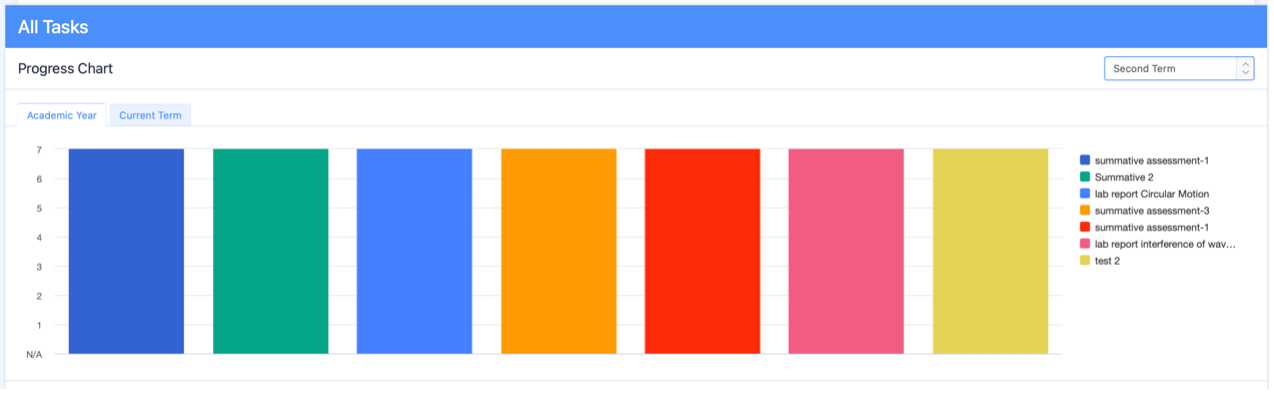
My FP physics teacher was Ariel Li, and my DP1 & DP2 physics teacher was Yang Liu. My physics grade has always been a 7 — you can see the specific scores in the appendix at the end.
My goal in writing this guide is to share my learning experience, revision methods, and exam techniques so they can serve as a reference, and so that everyone can comfortably raise their grade and pass IB Physics. Beyond just raising grades, though, I think some of the general study techniques and ways of thinking are also important, so I’ve folded those in as well.
I should also say that my writing style is on the verbose / technical side. If my prose doesn’t sit well with you, feel free to drop the whole article into an AI and have it rephrase the entire thing for you — it’ll probably read a lot more smoothly.
How to Study
I have a theory about learning: different learning mediums and methods cost dramatically different amounts of time. What I personally try to do is pick the most efficient and feasible method from the available options. So I’ve laid out a comparison of the common learning methods in the table below:
| Reason | Tradeoff | ||
|---|---|---|---|
| Learning method | Efficiency | Information density | Effort / ability required |
| Learning from top researchers | 6 | Extremely high, highly abstract | Extremely high |
| Academic papers | 5 | High | High |
| Textbooks | 4 | Medium-high | Medium |
| Online videos | 3 | Medium | Low |
| Classroom learning | 2 | Low | Low |
| Sleep / mindfulness / rest | 1 | None | Recovering |
| Slacking off | 0 | Lowest | Medium-high |
Table 1. Comparison of different learning methods by efficiency, information density, and effort / ability required
As you can see, classroom learning is not particularly efficient, because teachers have to accommodate students at different levels, keep things engaging, and speak at 1x speed. In contrast, for the average high school student, carefully produced videos or textbooks are a more efficient option. (Note: this is also true throughout university, grad school, and PhD — the way we learn shifts steadily up the table, and on top of that we start to innovate.)
For that reason, I lean heavily on Bilibili videos and textbook reading as my main study methods.
What follows is what I’ve learned from my own study journey, along with the resources I’ve used.
In Class
Even though the information density of classroom learning is low, that doesn’t mean it’s worthless. On the contrary, a lot of the subtle nuances in problem solving, the corrections in your thinking, and creative ideas all come out of class — they’re just buried in a lot of noise.
So if we listen selectively and pick which knowledge to absorb, we can effectively turn mandatory-attendance class time into self-study time.
In class, I mostly direct my attention to two things, and the rest of my focus goes to self-study.
First, I pay particular attention to the definition and introduction of any new concept, and try to understand why this piece of knowledge needs to exist at all. I think this helps build up some of the most basic intuitions, which are very useful both for solving problems and for understanding the world.
Second, whenever there’s an example problem or practice question in class, I’ll either do it mentally or write it out. If I get it wrong, I figure out which specific concept / formula / calculation / line of reasoning was the issue. At the same time, the most important thing is to figure out how to turn a single concrete problem into a general problem type, and to make sure I can re-articulate the reasoning approach for that problem type in detail. More specific problem-solving and summarizing techniques are covered later in the guide.
Outside the Classroom: How to Study
Resources and How to Use Them
1. Textbooks
First and foremost, the textbook is the most fundamental study and revision resource, because it’s the most directly tied to our IB syllabus. Typically, if you can read through the textbook once before the exam and work through the problems in it (and summarize the reasoning and problem types), you can already score quite well.
But as Table 1 shows, the reading time and effort that a textbook demands is usually too high for most students — especially for those of us trying to optimize our learning efficiency. So I’ll provide below a set of resources and methods I’ve personally tested to help us study more efficiently.
2. Bilibili videos
Because China is a country built around gaokao, all sorts of teachers and students have invented and shared a wide range of study methods, along with videos of every possible length and information density. And as the internet has grown, the quality of videos on video platforms has only gotten better, which makes Bilibili an indispensable part of my self-study workflow.
- Da Kuan Physics (most-used)
Link: Da Kuan | Five-Minute Physics Series playlist
Why it’s great: structurally complete; covers introduction, definitions, formulas, example problems, and practice in a short period of time. Very efficient.
The first one I want to recommend is from the creator Da Kuan. His Five-Minute Physics Series has no filler, the structure is very complete, and in just a few minutes you get the introduction, definitions, formulas, example problems, practice questions, etc. — extremely efficient.
At the same time, to make the knowledge really stick in your brain, you can’t just watch the video and call it done — you have to do active learning. Since each video’s knowledge structure is already clear and easy to follow, while watching each video, we can slot the relevant pieces of knowledge into the framework below, and try to memorize them:
- Definition
- Includes the conceptual definition, abbreviations, units, why it’s defined this way, etc.
- Properties (optional)
- Formulas
- Where the formula comes from, derivation, units, implications, etc.
- Basic example problems or problem-type templates
- What information is given, what’s being asked
- Which formula is used
- What’s the line of reasoning
- etc.
- Examples
- Supplements / special cases / etc.
Of course, the framework for each video might differ slightly, but on the whole this creator’s slides are very logical, so all you really need to do is end up with something structured and content-filled like the above in your head.
- 18 Days to Finish High School Physics
Link: 18 Days to Finish High School Physics | Bilibili video series
Characteristics: highly systematic, high information density, more in-depth — not suitable for last-minute cramming.
This video series has 18 lessons in total, each about 1–2 hours long. Because of that, the information density is quite high, so it’s not the right choice for the night before an exam.
It was originally produced for physics competition students, but I personally think both the content and the explanations are very accessible while still being deep. It’s a great fit for students who want to do competitions, and I’d also recommend it to anyone with spare time who wants to take their physics knowledge further.
- Mrs. Huang Physics
Link: Mrs. Huang Physics | Bilibili video collection
Characteristics: moderate length, comprehensive coverage of knowledge points, plenty of examples; suitable for daily study and patching gaps.
Compared with the two resources above, this video series sits more in the middle. Each video averages about 15 minutes. The creator is also well-known in the high school physics space — every video gets at least 2 million views — so the channel is widely loved and trusted by students.
Unlike the first resource’s minimalist style, this series covers the vast majority of knowledge points and comes with rich examples and explanations. It’s not necessarily ideal for last-minute cramming, but it’s great as a study companion while learning, or when there’s a concept you don’t understand and you want to hear this teacher explain it.
- Other Bilibili resources and how to search for them
It’s worth noting that every video series and every different teacher (including teachers at school) represents a different explanation style, knowledge system, information density, and so on.
So finding the videos and teachers that suit you is what matters most.
Before looking for resources, you need to figure out what your own preferences are: do you prefer an intuition-driven teacher or a logic-driven one, do you prefer high information density or very detailed explanations, and so on.
When searching for video resources there are also some tricks. Common keywords include “高中物理up主推荐” (high school physics creator recommendations), “高中物理精讲” (high school physics in-depth lectures), and so on.
3. Past Papers
When revising for physics, one of the most important parts of the process is grinding past papers. The core reason is that the entire point of our IB study and exams is the final IB exam, so for teachers, setting past-paper questions or questions similar to past papers is usually the easiest way to assess us. (And in practice that’s exactly what happens — teachers will typically include a decent amount of past-paper questions or just tweak the numbers.) Here are some past-paper resources and methods:
- Exammate (most-used)
In my opinion, the single best site, period. Its strengths:
- All of it is past-paper questions, with mark schemes
- Sorted by topic, which makes revision easy
Since you usually only need it right before exams, I’d recommend going to Taobao or Xianyu (Goofish) to search for exammate and buy a one-day or one-week membership — that’s the best value.
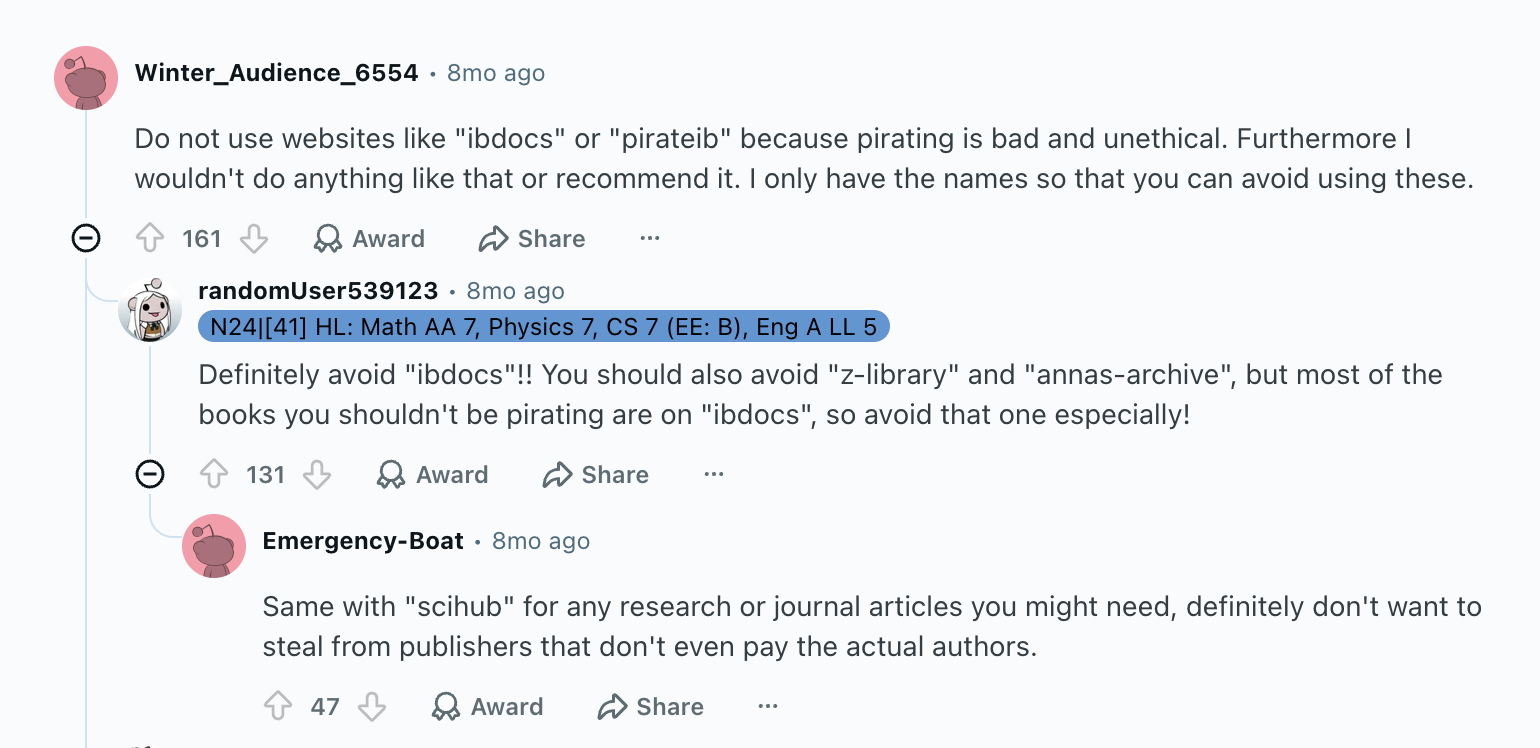
- PirateIB
Disclaimer:
This guide is purely a sharing of personal study experience. It does not encourage or endorse the use of pirated, infringing, or otherwise unauthorized study resources. The legality, safety, and accuracy of online resources are for the reader to judge independently, and the reader bears the consequences of using them. We recommend prioritizing your school library, official textbooks, legal databases, and openly available educational resources.
The site contains an extremely broad range of resources, including but not limited to past papers across many years, sample IAs / EEs, and various paid online resources.
Regardless of how you find these resources, this kind of past-paper material is typically used for the End of Year Exam, IB Mock Exam, and the IB exam itself, because those three are the most comprehensive exams, and teachers more often refer to past papers as a blueprint when writing them.
3.1 How to Grind Past Papers
First, you have to recognize that the total volume of knowledge we learn in high school is quite limited, so the kinds of problem types we’ll encounter is also quite limited (especially compared to competitions or research).
The point of grinding past papers is to use brute-force coverage to master every problem type, so as to compensate for the problems we can’t quite solve through raw cleverness — see the diagram below:
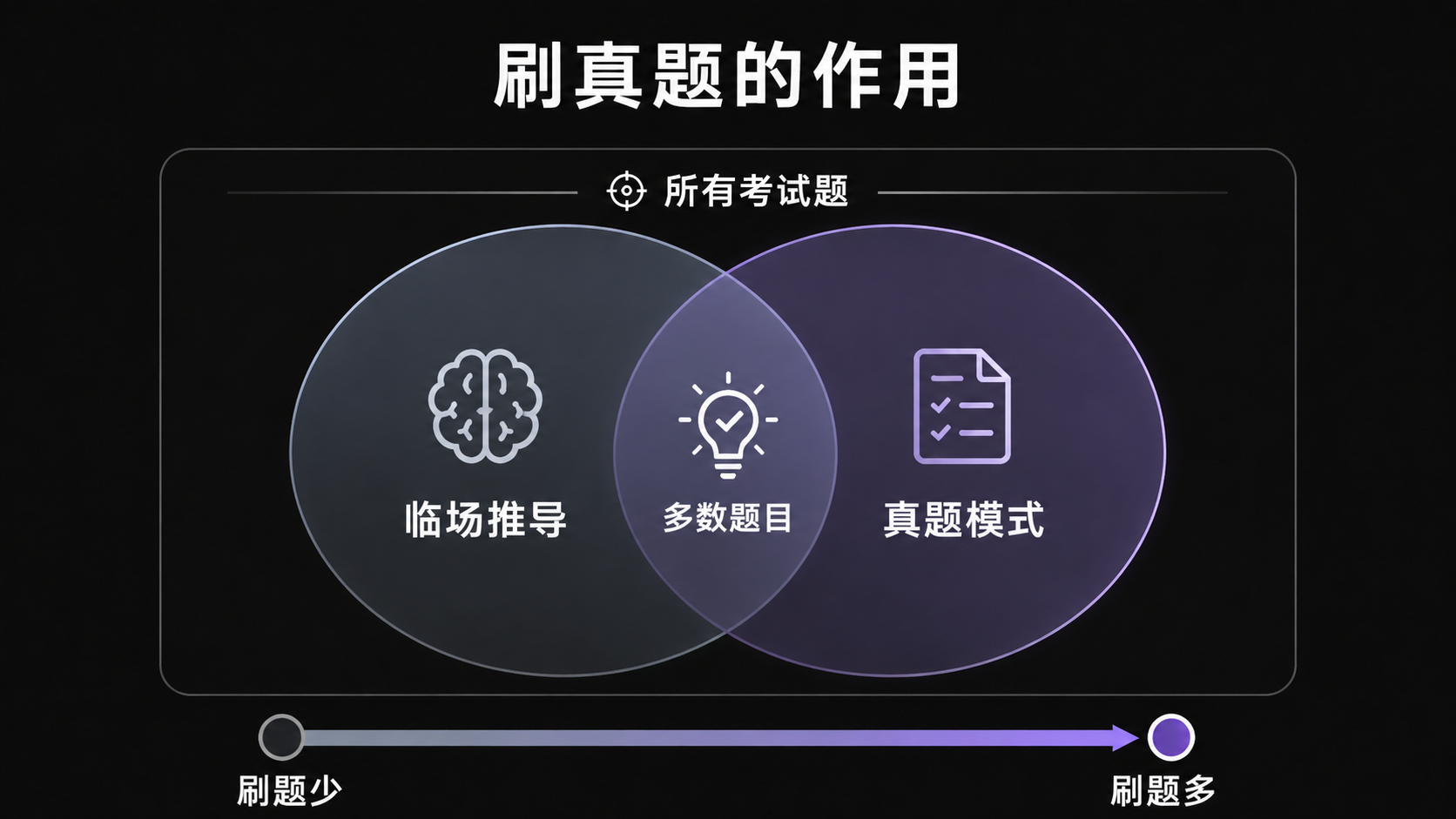
In other words, exam questions can roughly be split into two kinds:
One kind is solved on the fly via derivation and understanding;
The other is solved by drawing on problem types and patterns accumulated from past practice.
The more problems you do, the more complete your mental library of problem types becomes, and the less on-the-spot derivation you’ll need during the exam. Conversely, the fewer problems you do, the more you’ll have to rely on real-time analytical ability.
So the quantity, speed, depth, and whether-or-not-to-redo-mistakes of your problem grinding all depend on how confident you are in your own learning ability and ability to perform under pressure. Adjust to your own preferences.
Here I’ll share how I personally grind problems. After logging into exam-mate, I’ll pick the topic that falls within the exam’s scope, and then I’ll pick roughly the past three or four years’ worth of past-paper questions. For each question, I first try to solve it mentally; if that doesn’t work, I’ll try with pen and paper, then check the answer. Whether I get it right or wrong, after finishing I need to summarize what type of problem it is (mental summarization is fine; if you can’t hold it in your head, write it down), including:
- Which variables are given
- Which variable is being asked for
- Which formulas are used
- The line of reasoning (refer to the reasoning section below)
- Where I tend to slip up
- e.g. calculation, unfamiliar definitions / formulas …
Here’s the key point: after doing a few problems, your mental knowledge base will already contain quite a few problem types. So when you run into a new problem, you should first ask whether you can apply a problem type you’ve already summarized, or whether you can apply one with a small tweak.
Personally, for a given problem type and its variants, I only need to do one problem. So my pace through past papers is quite fast. You can observe for yourself how many problems it takes you to master a type, and improving on that dimension can dramatically speed up your learning. Specific techniques for speeding up are covered in the study techniques section.
4. Teaching Others Is Also a Way to Learn
Whether you call it the Feynman technique or you draw on personal experience, teaching others is a very effective way to consolidate your own knowledge system.
Specifically, when you’re teaching a classmate who possibly hasn’t paid attention for an entire unit, it forces us to stitch all the scattered pieces of knowledge, techniques, and example problems together with logic, while also balancing accessibility, attention to detail, fun, and pace (because you usually have to cover an entire chapter in a short window of time and make sure everyone can move on to actually doing problems).
At the same time, understanding how other people think and where their logic gets stuck can hugely improve your own teaching, comprehension, and metacognitive abilities. So I’d encourage everyone to try helping the classmates around you more often.
Techniques and Mindsets
Having covered the macro-level study process and resources, let’s look at, within the actual studying itself, what techniques can help us learn faster and remember more solidly.
Analogical Thinking
When encountering new knowledge, we can apply a known system or piece of knowledge to better understand and remember the new thing.
For a very simple example, when learning about electric fields, you can constantly draw analogies to gravitational fields. Mass experiences gravity; charge experiences an electric force. Gravitational potential energy and electric potential energy have a similar structure. The two are not identical in every detail, but this kind of analogy means that when you first encounter a new concept, you’re not starting from zero.
The example above is fairly obvious, and your teacher will introduce it in class. In practice, when you encounter a piece of knowledge that feels especially hard to memorize, you can deliberately apply this kind of thinking by asking yourself, what does this knowledge resemble / what can it be compared to?
Note: you can use anything as the basis for the analogy. The more familiar or everyday the analogy, the better the effect tends to be.
Variable vs. Constant
I trust everyone has learned the difference between variables and constants, so I’ll skip the standard usage.
In physics, you’ll notice that a formula is usually made up of several variables, e.g. F=mv/t or PV=nRT. At the high school level, you have to recognize clearly that a problem will usually pick only one or two of those variables and ask either how one variable changes, or how two variables change relative to each other.
So we need to focus our attention on the quantities that change, and appropriately ignore the constants.
This mindset suits two situations. One is when a problem is complex and involves a lot of concepts. At that point we have to identify exactly which elements stay fixed and which elements are being varied or solved for.
The other use case is in analysis-type problems like “When variable A increases, how will variable B change?”
Connecting to Reality
Physics is a subject about the laws of the real world, so no piece of knowledge should be divorced from real-world phenomena. When a concept feels abstract or obscure, you can think about what real-world examples or applications exist, and that usually makes it much easier to understand.
Knowledge as a System
This is the most important and most-used technique in my toolkit.
When learning a unit, I don’t just pay attention to the knowledge itself — I also pay attention to how the knowledge is being carried out.
For example, a lot of the time, the definition the teacher introduces at the very beginning might seem abrupt, but it likely exists to make the later explanations easier.
Or, in later physics where we’re learning more abstract topics, we usually go through the experiment first and then carry out the corresponding piece of knowledge. So when studying, you can memorize things in the same order.
This kind of ordering information is usually very useful while studying, because the person teaching has arranged this knowledge in a way that conforms to how cognition works. So if we also memorize things in that structure, and stay aware of the connections between pieces of knowledge, our study efficiency will go up dramatically.
For each unit or piece of knowledge, my brain usually presets a base framework that looks like this:
Introduction
- Real-world phenomenon
- Physics experiment
- Interesting historical story
Definition
- Conceptual definition
- Abbreviation
- Unit
- Subtle distinctions
- Why it's defined this way
Properties (optional)
- Vector / Scalar
- If it's a vector, how are the direction and magnitude determined
- Direct proportion, inverse proportion, square relationships, etc.
Formula
- Where the formula comes from
- Derivation
- The units inside the formula
- Various meanings
Examples or evidence
- Experiment
- Which variable's relationship with which variable is being studied
- Experimental phenomenon
- Graphs / tables
- Conclusion
- Everyday phenomenon
Basic example problem or problem-type template
- What information is given
- What's being asked
- Which formula is used
- What the line of reasoning is
- How to translate the problem's information into our structure
- Whether the framework can be extended
- etc.
Supplements / special cases
- Things that don't fit common patterns of cognition
- etc.
It’s worth noting that in actual use, this framework should be applied flexibly.
For example, we can use this framework on a specific piece of knowledge, or on an entire unit. Some pieces of knowledge only have a definition and a formula; others have a much more complete structure. The ordering can change too — sometimes the structure of a piece of knowledge goes definition → example → new definition → example → combined formula → ….
Likewise, for content not covered by the framework, you can add your own section, or build your own base framework entirely — forming your own knowledge tree.
Re-Understanding Equations
All formulas are carried out in the form of equations, but personally I’ve noticed that most students just memorize the equation itself. In reality, a single formula contains enormously rich information.
We can think of the equals sign as a bridge connecting two quantities, which means we can either read it from left to right, or read it from right to left.
Take the simplest example, F=ma:
- Read left to right, this is the most common interpretation: force equals the product of mass and acceleration. The product means that when acceleration is constant, the bigger the mass the bigger the force; when mass is constant, the bigger the acceleration the bigger the force. Vice versa.
- Read right to left, ma=F, we get a new angle: when we know there’s a mass undergoing some acceleration, we can derive the force acting on it.
If we rearrange to m=F/a: - Read left to right, this on its own doesn’t carry much meaning — it’s purely a relative relationship: m is inversely proportional to a, and directly proportional to F.
- Read right to left, we know that if an object has a force of magnitude F applied to it, and is moving with acceleration a, we can derive its mass.
And if we rearrange again to a=F/m: - By the same logic, we get two more interpretations.
So you can see that a single simple equation already has six distinct interpretations. This is why, when we say a problem uses a particular formula, we should specify which of the six interpretations is the one being used. With that kind of differentiation, distinguishing between different problem types becomes much easier.
On top of those six interpretations, we can also substitute in the definitions of different variables, creating yet more interpretations and equations.
For instance, F is fundamentally F_net, which can be gravity minus air resistance, the centripetal force in circular motion, etc. m doesn’t have that many extensions. And a can be written as delta v / delta t, which when substituted back gives us F=mv/t, generating a whole new family of interpretations.
If we can fully understand every formula in the formula booklet this way, along with their substituted variants, then picking and applying the right formula during problems is no longer something to worry about.
Anchoring
Whether it’s interpreting equations or the earlier variable-vs-constant idea, what we’re really doing is allocating our attention to the more important things or variables, and ignoring the unimportant ones.
In other words, we’re choosing some object as our anchor and building outward from there.
This mindset is extremely important and very generalizable. We can use a variable, an individual entity, or a particle as our anchor; we can equally well use a relationship, a structure, or a constraint as our anchor. When solving problems, we can also first identify the most critical conflict, goal, or invariant, and then organize our reasoning around it.
The same is true in studying. Beginners are often drowned by a flood of details, because they have no anchor: every formula, definition, and example problem looks equally important. Truly effective learning, on the other hand, usually starts by building a stable knowledge framework and then placing new knowledge within that framework. Details are no longer isolated bits of information — they become nodes attached to a structure.
In short, an anchor helps us lower the system’s complexity and the cost of understanding, reorganizing what was originally chaotic information. You can also dig deeper into how different anchors, and changes between anchors, affect understanding.
Generalization
I personally like to think of this as a kind of “leveling up in dimension”. If we treat the daily knowledge and the example problems themselves as the first layer, then their knowledge framework is what we get after generalizing them.
Likewise, anchoring is itself a generalization of the two techniques of equation interpretation and variables.
By generalization, I mean not stopping at a specific example, but instead going further and asking whether there’s a more general structure, or a more universal rule or way of thinking. Once you find that rule, you apply it to all sorts of things — that’s generalization.
What we need to do in studying physics is precisely this: go from “I can solve one problem” to “I can solve a class of problems”, and then to “I understand a way of thinking”.
(Similarly, the various study methods in this article can be extended to any science subject, or honestly any kind of knowledge. I’ve personally found this to be quite effective.)
Meta-cognition
The last technique I want to introduce is meta-cognition, which is awareness of your own thinking process.
If the earlier techniques — analogy, variable vs. constant, knowledge as a system, anchoring, generalization — are concrete learning tools, then meta-cognition is the ability that manages all of those tools. It lets us do more than just bury our heads in studying; it lets us step outside and observe ourselves: Do I actually understand this right now? Where am I stuck? Is the method I’m using effective? Is there a better angle?
Often, low study efficiency isn’t a matter of not working hard enough — it’s that we haven’t realized where exactly the problem is. For example, after getting a problem wrong, just reading the answer and remembering the solution gives the problem very limited value. But if we can go further and analyze whether our mistake was in the concept, the formula, the variable relationships, the problem’s structure, or our reasoning path, then that one problem can help us correct a whole class of issues.
So during studying, we can constantly do three things: set a clear goal before studying, monitor our own thinking during studying, and review afterward whether our method was effective and how to improve it. That way, we’re not passively absorbing knowledge; we’re actively tuning our own learning system.
From this perspective, meta-cognition is a layer of ability that sits above all the other learning techniques. It determines whether we can identify problems, pick methods, correct mistakes, and ultimately let our own way of learning continuously evolve.
(Optional) AI Study Tips
When I was in school, AI was just beginning to take off, but the landscape today is completely different.
I once watched an interview with someone who dropped out of high school but became a research scientist at OpenAI five years later through self-study. He said that in the past, people had to go through primary school, middle school, high school, college, and even grad school in order to learn AI, but his 13-year-old brother today can learn any topic within the AI field in three days.
Physics is the same. With the mindsets we’ve covered above, we can also better guide the AI to give us knowledge that fits a clear structure and is easy to understand.
Here are some prompts or keywords I commonly use when learning via AI:
- “Explain … intuitively”: the word intuitively gets the AI to explain things informally, and the answers are typically very easy to follow. I’ve also noticed that AIs tend to like adverbs.
- “Explain … step by step” / “Explain … using logic chain”: very useful when you need a detailed logical chain.
- “Explain … with a real-life example”: when a physics concept feels too abstract, you can have the AI come up with real-life examples.
- “You can use tables, analogies etc to help explain this concept”: you can specify any way of thinking or any technique, and have the AI transmit knowledge in that style.
How to Take the Exam
Having covered how to study, let’s now look at how to prepare for and how to take the exam.
How to Revise
For me, revision is essentially about permuting and combining the resources and techniques mentioned above. I’ll walk through my most-used revision modes.
If time is plentiful, I’ll read the textbook or PPT slides to revise everything, or slowly work through the various Bilibili videos to solidify the knowledge system, and then grind exam-mate past papers. That’s it.
If time is short — say I only have one evening or even just one morning, which (thanks to procrastination and the like) is extremely common — at that point we need extreme speed:
- First, check what’s in scope for this exam
- Watch all the corresponding Da Kuan Physics videos at 2x speed
- If there’s still time, eye-scan through the past-paper questions and answers on exam-mate. There’s usually no time to actually do the problems, so we just learn the reasoning behind the answers and how to handle some basic problem types.
- Definitely check whether you’re relatively familiar with the formulas in this unit’s formula booklet — at the very least, know what each quantity represents and its corresponding unit. That way even if you’ve never done a question on it, you have something to work with.
- Tell yourself not to panic, absolutely don’t make calculation mistakes, relax, and then go take the exam.
Problem-Solving / Exam Techniques
When you’re first encountering various problems, figuring out the reasoning is usually the step that traps people the most. At the same time, even with thorough preparation and revision, you’ll always run into surprise questions or questions you don’t know how to solve on exam day. So we need the following problem-solving / exam techniques to help us handle the unknown and generate lines of reasoning.
(Note: these techniques aren’t a particularly clean system — they’re a bunch of small tricks. You can solidify them as you do problems.)
General Techniques
The Units Trick
When facing a past-paper question, we often don’t know exactly which formulas we should use to get to the desired result. At that point, trying to recall every relevant definition, property, relationship, etc. can easily tie you up. So instead, let’s start from units.
Specifically, first observe which physical quantities the problem gives, and what units they each correspond to. Then look at what physical quantity the problem is ultimately asking for, and what its unit is.
Next, we think about how to multiply, divide, or combine the known units to produce the target unit.
Once we’ve found some operation that links the target quantity to the known quantities, we can go to the formula booklet to see whether a matching formula exists to verify our hypothesis. If there is one, then chances are this is the formula the problem wants you to use.
Enumeration
We know that the knowledge we’ve learned and the formulas we can use are finite, and teachers can’t (and almost certainly won’t) write out-of-syllabus questions. So we can enumerate one by one the knowledge we’ve learned and figure out which formula or definition is in play.
This technique is especially useful once you have your own knowledge tree, because you can quickly traverse all your knowledge and formulas, and judge for yourself how likely a given knowledge point is to be relevant. If the relevance is high, spend more energy thinking about whether it connects to the problem — this usually gives you a decent line of reasoning.
Working Backwards (and Working Forwards)
As the name suggests, it’s like finding the path out of a maze: we can work forwards from the conditions in the problem for a bit, and also work backwards from what the problem is asking for, identifying which quantities might be used or needed. As long as the two paths can be connected, the reasoning for the problem is complete.
Minimal Example
As the name suggests, when faced with a very complex problem that’s hard to understand, we can think about what the simplest case looks like, and then build up more complicated cases from there. For example, first think about what happens when n=0 and n=1, and then generalize to arbitrary n.
This technique can come up more often in IB HL physics or in math paper 3, so don’t get too attached to it.
Multiple Choice Techniques
Estimation
This is usually used in multiple choice (it can also be used to check work on free-response questions). Rather than calculating an exact value, we can estimate the approximate range of the magnitude, and then compare it against the answer choices.
We can also use this to eliminate options that are obviously wrong.
Game-Theoretic Selection (when we can’t solve a problem or need to guess)
This one is extremely useful and very commonly applicable. The underlying principle: for multiple choice, especially questions where each option spans multiple columns, the teacher will usually set up correct entries and distractor entries. To prevent students from just picking the answer based on a single column, teachers will typically make the number of distractor entries smaller than the number of correct entries, producing a 3-correct-1-distractor distribution, or a 2-correct-2-different-distractors distribution. So we can use this distribution alone to reverse-engineer the correct answer.
That sounds a bit complex, so let’s use a fun example to understand the technique:
Suppose our teacher forgot to print the problem. Please pick the correct answer from the options below:
| displacement | velocity | acceleration | |
|---|---|---|---|
| A | zero | maximum | zero |
| B | maximum | maximum | maximum |
| C | zero | zero | maximum |
| D | zero | maximum | maximum |
Now we look at the options. For the first column, zero appears three times and maximum appears only once. If we assume the rarer one (maximum) is actually correct, then we’d just pick B and could ignore the information from the other two columns. From the teacher’s perspective, that design would mean the knowledge points in the second and third columns get skipped — the knowledge coverage isn’t fully tested.
So the teacher would set the first column’s answer as zero rather than maximum. We can eliminate option B.
By the same logic, looking at the second and third columns, we have one zero and three maximums, so we can eliminate options A and C.
So the final answer is D.
Of course, this particular question is pretty obvious, but we can extend the method and apply it to the following two different examples:
| displacement | velocity | acceleration | |
|---|---|---|---|
| A | zero | maximum | zero |
| B | maximum | zero | maximum |
| C | zero | zero | maximum |
| D | zero | maximum | constant |
In this example, zero appears three times in the first column, so we eliminate the lone maximum: B.
The second column has two maximums and two zeros — no information, skip for now.
The third column has maximum appearing twice, which is the most-appearing one, so we prioritize maximum.
That gives us displacement = zero, acceleration = maximum.
The only option that satisfies both is C.
| Q | R | S | |
|---|---|---|---|
| A | proton | neutron | electron |
| B | proton | electron | alpha |
| C | neutron | neutron | alpha |
| D | electron | alpha | electron |
Similarly, for this example, proton appears the most times in column Q.
neutron appears the most times in column R.
In column S, electron and alpha each appear twice — no information, skip.
So we get Q = proton, R = neutron.
The only option that satisfies both is A.
After working through these examples, you can see that the essence of this technique is finding the unbalanced option and reverse-engineering the answer by eliminating the minority entries.
Of course, it doesn’t always directly point to the final answer, but even if it only eliminates one or two options, that can push our accuracy from 25% up to 33% or 50%.
One caveat: this technique has a limitation — you’ll only run into questions like these in small exams like quizzes and regular tests. For IB exam-scale exams, the question writers are usually aware of this and will deliberately design the options to be very balanced.
Last Resorts
Sometimes no matter how hard we try, there will be problems we just can’t crack. Even so, don’t give up — we can try the two techniques below to boost our chances of guessing the right answer.
Guessing and Trial-and-Error
As the name suggests, we make reasonable guesses based on the numbers we already have. What I usually do is:
- Plug numbers into formulas at random, or mash existing values into the calculator to see what comes out that matches an option or looks reasonable
- Guess special values like 0, 1, -1
- Imagine the logical relationships between variables and pick the most reasonable one
- Use intuition to pick the answer that feels most likely
Farming Method Marks
For free-response questions you can’t do, you also shouldn’t leave them blank. Most physics teachers at our school are quite generous with marks, so we should work to grab some method marks.
That said, we shouldn’t write anything blindly. If it’s a calculation question, the main mark points are the formula and the calculation process, so just pick one or two relevant formulas, write them down verbatim, try substituting in the values, and ballpark a calculation.
If it’s an explanation question, we should write out the definitions of the concepts that appear in the problem, or write out the definition of a relevant law from memory. From what I remember, the common concepts for picking up method marks are Newton’s second law and the definition of temperature.
Lab report
Due to length constraints, I’ll start a separate article specifically on how to understand and template-ify writing a high-scoring lab report.
Closing Thoughts
Thank you for reading all the way through. As you can probably tell, I’m not a conventional, by-the-book learner — I tend to look for the most efficient study methods and techniques.
I’m personally someone who leans on visual / pictorial memory, but as the many techniques in this guide suggest, I’m not purely intuition-driven either — I learn through a combination of intuition and logic. At the same time, because I went to primary school in mainland China, my calculation foundation and speed lean fast.
I mention these things because I believe there are many different types of learners in the world, and techniques shared by someone with similar traits tend to be more useful to you.
So you don’t need to copy my study style wholesale — rather, based on your own foundation, goals, and study habits, pick the parts that suit you and use them.
Finally, I want to mention some foundations for studying physics, and the sciences in general.
Calculation Fundamentals
Since Paper 1 doesn’t allow calculators, mental math and pen-and-paper calculation ability matter a lot.
I’d suggest that students with a weaker foundation read up on some mental-math techniques day-to-day, and try doing some primary-school mental arithmetic problems and equation-manipulation practice. Ideally, beyond pure numerical calculation, most arithmetic and substitution should be doable mentally (e.g. some simple physics-formula derivations can be done verbally rather than on paper).
Interest
Last of all: this entire guide has been about techniques, but interest — interest in physics, in the truths of the world, in the laws themselves — is the most fundamental driver of all of this.
So I’d recommend regularly watching all kinds of physics videos in your day-to-day life, including but not limited to creators like 3B1B, Veritasium, and MoeMoe Squad.
I hope you can always keep your interest in knowledge alive, and that you can pass IB Physics with flying colors.
Appendix
FP physics grade screenshot:

DP1 physics grade screenshot (I forgot to screenshot DP2 — apart from one exam where I got a 6, the rest were all 7s):